Tuesday, July 1, 2025

A Miniature Clockwork Papercraft Train Diorama - by Time Tripper

Here is a project that is both charming and intriguing: a tiny paper train diorama that actually moves, created by a Japanese artist who goes by the enigmatic pseudonym Time Tripper. 

This miniature model, measuring just 7 cm by 7 cm, is entirely handcrafted and stands out not only for its delicate appearance, but especially for the functional mechanism hidden inside its structure. 

The little train moves slowly, in a rhythmic and continuous motion, powered by a 100-yen clock module — a mechanism often used in paper-based motion projects in Japan (commonly sold in the West at party supply stores). 

What’s most curious is that, at first glance, the model looks like a simple paper craft. But upon closer inspection, you begin to notice the clever engineering hidden inside the tunnel and the small house in the scene. 

The creator explains that the idea came to him unintentionally, while he was organizing old New Year’s cards. In trying to reuse those cards for new projects, he had a sudden spark of inspiration that led to the creation of this tiny, moving world. 

And what’s even more interesting: although it’s a train, the artist makes it clear he’s not actually a fan of trains. What fascinates him are dioramas as a form of artistic expression, with the train acting purely as a visual and mechanical element within the scene. 

Besides this model, Time Tripper’s website - which sadly went offline around 2010 - also showcased a few other experimental ideas, such as a radio made with paper and aluminum foil, and even a miniature carving machine of sorts. 

However, none of these projects were ever completed or fully released. The site itself was very simple and mysterious, offering very little information about the creator, who never revealed his real name. All we’re left with are his rare and brilliant creations - like this little moving paper wonder. 

The model was digitally designed in CAD, with applied textures, then printed and assembled by hand. The structure, though it appears fragile, is cleverly built: the train and its wagons are shaped like quarter-circles, moving together along a circular base. 

Everything is supported by two small paper rods attached to the body of the train, which slot into the arm of the mechanism driven by the clock module’s second hand. The result is a smooth, continuous circular motion — hypnotic to watch. 

To complete the presentation, the creator placed the diorama inside an 8 cm plastic box purchased from a 100-yen store. It fits perfectly, protecting the model from dust and giving it the finishing touch, like a tiny framed piece of kinetic art. He even joked that maybe it could be sold - though the inclusion of the box doubled the production cost to 200 yen! 

This kind of project is a perfect reminder that in the world of papercraft, the magic isn’t only in the visual detail, but in the emotion that a piece can convey. Even something as small and humble as this diorama has the power to spark the imagination, inviting us into a miniature world where everything moves - silently - to the rhythm of a ticking second hand.

Eis aqui um projeto que é, ao mesmo tempo, encantador e intrigante: um minúsculo diorama de trem feito em papel que realmente se move, criado por um artista japonês que atende pelo enigmático pseudônimo de Time Tripper. 

Esse pequeno modelo, com apenas 7 cm por 7 cm, é inteiramente artesanal e se destaca não só pelo visual delicado, mas principalmente por conter um mecanismo funcional escondido dentro de sua estrutura. 

O trenzinho se move aos poucos, de forma rítmica e contínua, graças a um módulo de relógio de 100 ienes (vendido no Ocidente em casas de artigos de festas) de um recurso muito utilizado em projetos de papel com movimento no Japão. 

O mais curioso é que, à primeira vista, o modelo parece apenas um simples artesanato em papel, mas quando você observa com atenção, percebe a engenhosidade dos mecanismos escondidos dentro do túnel e da casinha do cenário. 

O criador revela que a ideia surgiu de maneira despretensiosa, enquanto organizava antigos cartões de Ano Novo. Ao tentar reaproveitar esses cartões para novos projetos, acabou tendo o estalo que o levou à criação deste pequeno universo em miniatura. 

E o mais interessante: embora seja um trem, o autor deixa claro que não é um fã de ferrovias. O fascínio dele está nos dioramas como forma de expressão artística, onde o trem funciona apenas como elemento visual e mecânico dentro da cena. 

Além desse modelo, o site de Time Tripper - que infelizmente saiu do ar por volta de 2010 - também apresentava algumas outras ideias experimentais, como um rádio feito com papel e folhas de alumínio, e até uma espécie de máquina de esculpir em miniatura, mas nenhum desses projetos chegou a ser finalizado ou disponibilizado em sua totalidade. 

O site era extremamente simples e misterioso, com pouquíssimas informações sobre seu autor, que nunca revelou seu nome verdadeiro. Ficamos apenas com as criações - raras e geniais - como essa pequena maravilha de papel em movimento. 

O modelo foi projetado digitalmente em CAD, com texturas aplicadas e depois impressas para montagem manual. A estrutura, apesar de parecer frágil, é bem planejada: o trem e os vagões têm formato de quarto de círculo e se movem juntos sobre uma base circular. 

Tudo é sustentado por dois bastões de papel presos ao corpo do trem, que se encaixam no braço do mecanismo conectado ao ponteiro dos segundos do módulo de relógio. O resultado é um movimento circular suave e contínuo, hipnotizante de se ver. 

Para completar a apresentação, o autor acondicionou o diorama em uma caixinha de 8 cm comprada em loja de 100 ienes, o que protege contra poeira e dá um toque final de acabamento, como se fosse uma pequena obra de arte emoldurada. 

Ele mesmo brinca que talvez isso até pudesse ser vendido — embora o custo tenha dobrado para 200 ienes por conta da caixinha. Esse tipo de projeto é um ótimo lembrete de que, no mundo do papercraft, a magia não está apenas nos detalhes visuais, mas na emoção que uma peça consegue transmitir. 

Mesmo que seja algo pequeno e modesto, como esse diorama, ele é capaz de tocar a imaginação de quem vê, convidando para um mundo em miniatura onde tudo se move, silenciosamente, ao ritmo de um ponteiro de relógio.


Link:
A.Miniature.Clockwork.Papercraft.Train.Diorama.by.Time.Tripper


More Unusual Paper Models related posts:


Sunday, June 29, 2025

Easy-To-Build Surf-Combi Miniature Papercraft - by Oliver Dorrell

Here is a super stylish and full-of-personality paper model: the Surf-Combi, a charming retro van with a surfboard on the roof, offered for free by the talented British designer Oliver Dorrell, creator of the Papermotiv brand. 

This model was developed as a way to promote his own papercraft company, and it's a great example of the clean and elegant style that defines his work, minimal cuts, clever folds, and striking visuals, all designed to make assembly fun and hassle-free. 

Oliver Dorrell holds a degree in Transport and Product Design from Coventry University and has a very particular approach to paper: he aims to replicate the look of real objects with the least amount of complexity, always exploring the full potential of paper as a construction material. 

His creations include classic cars, tanks, helicopters, and promotional models for museums and educational institutions. 

In addition to being a designer, Dorrell is also a visual artist, with paintings and illustrations inspired by landscapes from around the world, from the Alps to the Himalayas. 

But it's through Papermotiv that he brings his passion for design directly to the public: a small independent company dedicated to realistic, practical, and beautiful paper models, with a focus on accessibility and good design. 

If you enjoy well-made, quick-to-build models full of charm, don’t forget to visit the official website and download your free Surf-Combi. 

In the third image of this post you can see some more of Mr. Dorrell's work.

Eis aqui um modelo de papel super estiloso e cheio de personalidade: a Surf-Combi, uma simpática van retrô com prancha no teto, oferecida gratuitamente pelo talentoso designer britânico Oliver Dorrell, criador da marca Papermotiv. 

Esse modelo foi desenvolvido como uma forma de promover sua própria empresa de papercrafts, e é um ótimo exemplo do estilo clean e elegante que define seus trabalhos, poucos cortes, dobras inteligentes e visual impactante, tudo pensado para que a montagem seja divertida e descomplicada. 

Oliver Dorrell é formado em Design de Transporte e Produto pela Coventry University e tem uma abordagem muito particular para o papel: ele busca replicar o visual dos objetos reais com o mínimo de complicação, sempre explorando ao máximo as qualidades do papel como material construtivo. 

Suas criações incluem carros clássicos, tanques, helicópteros e modelos promocionais para museus e instituições educativas. 

Além de designer, Dorrell também atua como artista plástico, com pinturas e ilustrações inspiradas em paisagens do mundo todo, dos Alpes ao Himalaia. 

Mas é com a Papermotiv que ele leva sua paixão pelo design direto para o público: uma pequena empresa independente dedicada a modelos de papel realistas, práticos e bonitos, com foco na acessibilidade e no bom design. 

Se você gosta de modelos bem feitos, rápidos de montar e cheios de charme, não deixe de visitar o site oficial e baixar a sua Surf-Combi gratuitamente. 

Na imagem abaixo você pode ver mais alguns trabalhos do Sr. Dorrell.


Link:
Easy.To.Build.Surf.Combi.Miniature.Papercraft.by.Oliver.Dorrell


More Papercraft Vehicles related posts:


Saturday, June 28, 2025

WW2 M3 Lee Desert Rats Tank Paper Model - by Model Lover

Here is a beautiful paper model of the M3 Lee tank, featuring the typical camouflage used by the British Desert Rats during the North African campaign. 

The model was created by the mysterious designer known as Model Lover, who also goes by the names John Vector, Eugene, or even John Baker, depending on which platform you find him on. 

His identity remains a mystery - some say he’s Russian, but that he currently lives in Vietnam, Turkey, or Kyrgyzstan. Honestly, he might just be a secret agent who loves papercraft… or someone with a great sense of humor. 

Regardless, what really matters is that his models are of exceptional quality. Most of his work focuses on military vehicles like tanks, APCs, trucks, and even airplanes,  all with realistic textures, straightforward assembly, and video instructions often available online. 

This M3 Lee is a great example: it takes only two printed sheets to build a well-shaped 3D tank. The digital texture work is excellent, with a natural-looking desert camouflage in ochre and sand tones, along with details like rivets, overlapping plates, and British identification markings on the sides. 

The track sections feature wheels in simulated perspective, eliminating the need for internal structure, but still delivering a convincing visual effect. 

The parts are smartly arranged: the main hull and turret are on one sheet, while the tracks, wheels, base, and smaller elements are on the other. 

There are even assembly guides, like red arrows on some circular parts, and a QR code linking to a video tutorial,  a modern and practical touch. 

All of this shows the designer’s care in offering models that are both good-looking and beginner-friendly. The M3 Lee tank looked improvised but had the soul of a survivor. 

Tall, heavy, and with two guns mounted in different positions — one in the turret and another fixed to the hull,  it looked like a rushed design, which it really was. 

But during the North African campaign, especially in the hands of the Desert Rats, it proved to be reliable, well-armed, and tough enough to withstand the harsh desert conditions. 

Because of its height, nearly three meters, it was sometimes used as an improvised observation post. The British version, known as the M3 Grant, had a redesigned turret and radios adapted to Commonwealth standards. 

Soldiers even gave it the nickname “Iron Cathedral”, due to its unusually spacious interior, where you could actually stand up,  quite a luxury inside an armored fighting vehicle.

If you liked this model, I highly recommend visiting Model Lover’s Pinterest page. There you’ll find a huge collection of free paper models: tanks, trucks, cars, motorcycles, and even some buildings. 

And if you want to support this amazing work, he also accepts donations via PayPal. All the links will be at the end of the post.

Eis aqui um belo modelo de papel do tanque M3 Lee, com a camuflagem típica dos Desert Rats britânicos. 

O modelo foi criado pelo misterioso designer conhecido como Model Lover, também chamado de John Vector, Eugene ou até John Baker, dependendo da plataforma em que você o encontra. 

A identidade dele continua um enigma, dizem que é russo, mas que vive no Vietnã, na Turquia ou no Quirguistão. 

Francamente, ele pode muito bem ser um agente secreto que ama papercraft, ou só alguém com muito senso de humor. 

Independente disso, o que realmente importa é que seus modelos são de altíssima qualidade. A maioria gira em torno de veículos militares como tanques, APCs, caminhões e até aviões, sempre com texturas realistas, montagem descomplicada e instruções muitas vezes disponíveis em vídeo. 

Este M3 Lee é um bom exemplo: com apenas duas folhas impressas, ele forma um tanque tridimensional muito bem resolvido. 

O trabalho de textura digital é excelente, com o padrão de camuflagem em tons de ocre e areia aplicado com naturalidade, além de detalhes como rebitagem, painéis sobrepostos e marcações de identificação britânicas nas laterais. 

As peças das esteiras vêm com as rodas em perspectiva simulada, o que dispensa partes internas complexas, mas ainda assim entrega um visual convincente. 

As partes são distribuídas de forma eficiente: a estrutura principal do casco e da torre está em uma folha, enquanto as esteiras, rodas, fundo e peças menores estão na outra. 

Há até guias de montagem com setas vermelhas em alguns elementos circulares e um QR code que leva a um vídeo com instruções,  um toque moderno e prático. Tudo isso mostra o cuidado do designer em oferecer um modelo que seja ao mesmo tempo bonito e acessível, mesmo para iniciantes. 

O tanque M3 Lee tinha cara de improviso e alma de resistência. Alto, pesado e com dois canhões montados em posições diferentes, um na torre e outro no casco, ele parecia um projeto apressado, o que de fato era. 

Mas durante a campanha do Norte da África, especialmente nas mãos dos Desert Rats, mostrou que era confiável, bem armado e aguentava o tranco nas condições adversas do deserto. 

Por ser tão alto, com quase três metros, ele chegou a ser usado como ponto de observação improvisado. 

A versão britânica, chamada M3 Grant, trazia modificações na torre e rádios adaptados ao padrão da Commonwealth. 

Os soldados, inclusive, apelidaram o tanque de “Catedral de Ferro”, por causa do interior espaçoso onde até se podia ficar em pé, um verdadeiro luxo em se tratando de um veículo blindado da época. 

Se você gostou deste modelo, recomendo visitar o Pinterest de Model Lover. Lá você vai encontrar uma coleção enorme de modelos de papel gratuitos: tanques, caminhões, carros, motos e até construções. 

E se quiser apoiar esse trabalho incrível, ele também aceita doações via PayPal. Todos os links estarão no final do post.


Link to download the model:
WW2.M3.Lee.Desert.Rats.Tank.Paper.Model. by.Model.Lover


More Paper Models of Military Vehicles related posts:


Friday, June 27, 2025

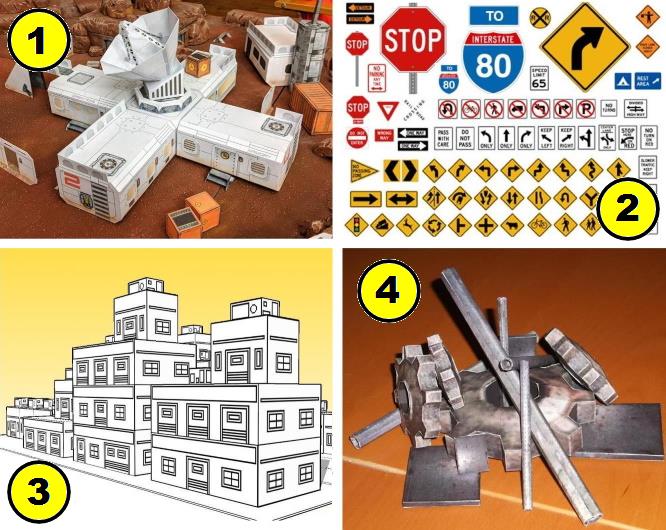
Customizable Generic Cyberpunk Building Papercraft - by Papermau
Download Next Week!


More Paper Models for Dioramas, RPG and Wargames related posts:


A Desktop Terrestrial Globe Papercraft - by Rob Ives - via Brother

Taking up five printed sheets and featuring illustrated, highly detailed instructions, this desktop globe was created by Rob Ives exclusively for the printer manufacturer Brother's website. 

Rob Ives is a renowned British designer and paper engineer, specializing in papercraft and paper automata. A former math and science teacher, he now works full-time creating intricate paper models, many of which feature animated, fully functional mechanisms. 

He is the author of several popular books, including Paper Locksmith and Paper Automata (published in 2025, with hands-on instructions for building paper automata), as well as titles aimed at children and makers, such as the Build It! Make It! series, which explores topics like dinosaurs and space projects. 

In addition to his books, Rob Ives offers a wide variety of free resources on his website, including models of owls, dogs, dragons, and other quirky creations. He also runs school workshops, promoting the teaching of design and technology through creative papercraft activities. 

His models are perfect for both craft enthusiasts and educators looking to introduce mechanical concepts in a fun, accessible, and engaging way. 

Did you know that the first known terrestrial globe was created in 1492? Called the Erdapfel, which means “Earth Apple” in German, it was built by Martin Behaim, a German cartographer and navigator. 

Interestingly, this globe predates Columbus’s arrival in the Americas, so the American continent is completely absent! The Erdapfel is considered the oldest surviving globe and is preserved today at the German National Museum in Nuremberg. 

During the 16th and 17th centuries, terrestrial globes were not only scientific or educational tools, they also served a decorative role and were seen as symbols of status and scholarship. 

Often, they came in pairs: one terrestrial and one celestial, the latter displaying the constellations. These elegant objects commonly adorned libraries, studies, and the private offices of scholars and noblemen. 

Today, globes have evolved considerably. In addition to the traditional kind, there are inflatable classroom globes, digital interactive versions with augmented reality features, and even tactile globes with braille inscriptions, specially designed for visually impaired users. 

Technology has brought new ways to explore our planet, but the fascination with these spherical representations of the Earth remains as strong as ever.

Ocupando cinco folhas impressas e acompanhado de instruções ilustradas e super detalhadas, este globo terrestre de mesa foi criado por Rob Ives exclusivamente para o site da fabricante de impressoras Brother. 

Rob Ives é um renomado designer britânico e engenheiro de papel (paper engineer), especializado em papercraft e autômatos de papel. Ex-professor de matemática e ciências, ele se dedica atualmente em tempo integral à criação de modelos em papel, muitos deles com mecanismos animados e totalmente funcionais. 

Autor de diversos livros populares, Rob lançou títulos como Paper Locksmith e Paper Automata (publicado em 2025, com instruções práticas para montar autômatos de papel), além de obras voltadas para o público infantil e maker, como a série Build It! Make It!, que explora temas como dinossauros e projetos espaciais. 

Além dos livros, ele oferece inúmeros recursos gratuitos em seu site,  incluindo modelos de corujas, cachorros, dragões e outros projetos curiosos. Também realiza workshops em escolas, incentivando o ensino de tecnologia e design de forma criativa por meio do papercraft. 

Seus modelos são ideais tanto para entusiastas do artesanato quanto para educadores que desejam apresentar princípios mecânicos de forma lúdica, acessível e divertida. 

Você sabia que o primeiro globo terrestre de que se tem notícia foi criado em 1492? Chamado Erdapfel, que significa “maçã da Terra”, em alemão, ele foi construído por Martin Behaim, um cartógrafo e navegante alemão. 

Curiosamente, esse globo foi feito antes da chegada de Cristóvão Colombo às Américas, por isso o continente americano simplesmente não aparece! O Erdapfel é considerado o globo mais antigo ainda existente e está preservado até hoje no Museu Nacional da Alemanha, em Nuremberg. 

Durante os séculos XVI e XVII, os globos terrestres não eram usados apenas como instrumentos científicos ou educacionais. Eles também exerciam forte apelo decorativo e eram considerados símbolos de status e erudição. 

Com frequência, vinham em pares, um globo terrestre e outro celeste, com representações das constelações, e decoravam bibliotecas, escritórios e gabinetes de estudiosos e nobres. 

Nos dias de hoje, os globos evoluíram bastante. Além dos modelos tradicionais, existem versões infláveis, muito comuns em salas de aula; globos digitais com recursos interativos e de realidade aumentada; e até globos táteis com inscrições em braile, desenvolvidos especialmente para pessoas com deficiência visual. 

A tecnologia trouxe novas maneiras de explorar o planeta, mas o fascínio por esse objeto esférico continua o mesmo desde o século XV.


Link:
A.Desktop.Terrestrial.Globe.Papercraft.by.Rob.Ives.via.Brother


More Paper Models of Globes related posts: