Showing posts with label tank. Show all posts

Wednesday, September 30, 2026

Japanese Type 1 Ho-Ni I Self-Propelled Gun Papercraft In 1/48 Scale
by Hakoko

Japanese Type 1 Ho-Ni I self-propelled gun detailed 1/48 scale papercraft by Hakoko from Box Studio

Created by talented Japanese designer Hakoko, from Box Studio, this is a truly impressive paper model of the Type 1 Ho-Ni I, or 一式砲戦車 ホニI, a Japanese self-propelled gun used during World War II.

The model is in 1/48 scale and, once assembled, measures approximately 12.2 cm long, 4.7 cm wide and 5.3 cm high. The templates consist of four pages of parts, plus four additional pages intended for printing on the reverse side. The author also provides a separate assembly manual and a diagram showing the fold lines.

As we have already seen in other works by Hakoko featured here on Papermau, the level of finish is exceptional. Looking at the photos, it is easy to forget for a moment that we are looking at a model made entirely of paper. The result looks very much like a carefully assembled and painted plastic kit, especially because of the textures, realistic weathering effects, and the detailed wheels, suspension and tracks.

This is not a model for beginners. There are many small parts, especially around the running gear and gun, but the construction has been very well planned. In his building diary, Hakoko shows the internal structure of the hull, the application of the outer covering, the assembly of the fighting compartment and gun, and finally the complex suspension and track system. Interestingly, he mentions that he considerably simplified the interior area around the driver's position.

The real vehicle on which this papercraft is based also has an interesting history. The Type 1 Ho-Ni I was developed to provide Imperial Japanese Army armored divisions with a more powerful mobile weapon. Instead of designing an entirely new vehicle, Japanese engineers used the chassis and engine of the well-known Type 97 Chi-Ha medium tank and replaced its turret with a 75 mm Type 90 field gun mounted behind an open fighting compartment.

One interesting fact is precisely this origin: beneath its completely different appearance, much of the Ho-Ni I was essentially still a Type 97 Chi-Ha.

Another interesting detail is that its role was not simply to hunt enemy tanks. The Ho-Ni I was also conceived as self-propelled artillery to accompany armored units, and its gun could be used against targets at considerable distances. Its open fighting compartment, however, left the crew exposed, and the vehicle did not carry a defensive machine gun, a serious disadvantage in close combat.

Finally, the Ho-Ni I was a rare machine. Only about 26 examples of this first version were produced in 1942. Some were sent to the Philippines and took part in the Battle of Luzon in 1945, while many vehicles of the Ho-Ni family remained in Japan to defend the home islands against a possible Allied invasion that never took place.

Hakoko provides the templates, assembly manual and fold-line diagram for free at Box Studio. For anyone interested in Japanese military vehicles and looking for a more detailed project, this is one of those papercrafts that shows just how far you can go with nothing more than paper, patience and a good printer.

Side view of the Japanese Type 1 Ho-Ni I self-propelled gun 1/48 scale papercraft by Hakoko, showing the detailed tracks and suspension

Criado pelo talentoso designer japonês Hakoko, do site Box Studio, este é um modelo em papel realmente impressionante do Type 1 Ho-Ni I, ou 一式砲戦車 ホニI, um canhão autopropulsado japonês utilizado durante a Segunda Guerra Mundial.

O modelo está na escala 1/48 e, depois de montado, mede aproximadamente 12,2 cm de comprimento, 4,7 cm de largura e 5,3 cm de altura. Os templates ocupam quatro folhas de peças, com outras quatro páginas destinadas à impressão no verso, e o autor também disponibiliza separadamente um manual de montagem e um diagrama com as linhas de dobra.

Como já vimos em outros trabalhos de Hakoko publicados aqui no Papermau, o nível de acabamento é excepcional. Visto nas fotografias, é fácil esquecer por alguns instantes que estamos olhando para um modelo feito inteiramente de papel. O resultado lembra muito um kit plástico cuidadosamente montado e pintado, principalmente pelas texturas, pelos efeitos de desgaste e envelhecimento, e pelo detalhamento das rodas, suspensão e esteiras.

Não é um modelo para iniciantes. Há muitas peças pequenas, especialmente no conjunto de rodagem e no canhão, mas a construção foi muito bem planejada. No diário de montagem, Hakoko mostra a estrutura interna do casco, a aplicação do revestimento externo, a montagem da área de combate, do canhão e finalmente do complexo conjunto de suspensão e esteiras. Curiosamente, ele comenta que simplificou bastante a região interna próxima ao posto do motorista.

O veículo real no qual este papercraft é baseado também tem uma história interessante. O Type 1 Ho-Ni I surgiu da necessidade do Exército Imperial Japonês de fornecer às suas divisões blindadas uma arma móvel mais poderosa. Em vez de desenvolver um veículo totalmente novo, os engenheiros aproveitaram o chassi e o motor do conhecido tanque médio Type 97 Chi-Ha e substituíram sua torre por um canhão de campanha Type 90 de 75 mm instalado em um compartimento de combate aberto.

Uma primeira curiosidade é justamente essa origem: por baixo da aparência completamente diferente, grande parte do Ho-Ni I continuava sendo essencialmente um Type 97 Chi-Ha.

Outra é que sua função não era simplesmente caçar tanques. O Ho-Ni I foi concebido também como artilharia autopropulsada para acompanhar unidades blindadas, e seu canhão podia ser utilizado contra alvos a grandes distâncias. A configuração aberta, entretanto, deixava a tripulação bastante exposta e o veículo sequer possuía uma metralhadora defensiva, uma séria desvantagem em combate próximo.

Por fim, o Ho-Ni I foi uma máquina rara. Apenas cerca de 26 exemplares dessa primeira versão foram produzidos em 1942. Alguns chegaram às Filipinas e participaram da Batalha de Luzon em 1945, enquanto muitos veículos da família Ho-Ni permaneceram no Japão para a defesa das ilhas contra uma possível invasão aliada que nunca aconteceu.

Hakoko disponibiliza gratuitamente os templates, o manual de montagem e o diagrama das linhas de dobra no Box Studio. Para quem gosta de veículos militares japoneses e procura um projeto mais detalhado, este é daqueles papercrafts que mostram até onde se pode chegar trabalhando apenas com papel, paciência e uma boa impressora.

Front and side views of the Japanese Type 1 Ho-Ni I 1/48 scale papercraft by Hakoko, showing the open fighting compartment, gun and detailed tracks
Miniature preview of the Type 1 Ho-Ni I papercraft templates and assembly instructions by Hakoko, shown for visualization purposes only

Build this highly detailed Type 1 Ho-Ni I in 1/48 scale using the free templates available at the link below:

Japanese Type 1 Ho-Ni I Self-Propelled Gun Papercraft In 1/48 Scale - by Hakoko

Papermau papercraft post divider

If you enjoyed this detailed Type 1 Ho-Ni I, take a look below at four more impressive military vehicle papercrafts:

Four detailed World War II tank and armored vehicle free papercrafts in scale, featuring the 7TP, Nashorn, M3A1 and LVT(A)-1 via Papermau

01: Polish 7TP dw Twin-Turret Light Tank Paper Model In 1/48 Scale - by Hakoko

02: Heavy Tank Destroyer Nashorn Paper Model In 1/48 Scale - by Hakoko

03: WW2`s Light Tank M3A1 Paper Model In 1/72 Scale - by Mr. Cube

04: LVT(A)-1 708th Amphibian Tank Battalion Paper Model In 1/72 Scale - by Paper Diorama

Papermau papercraft post divider


Papermau papercraft post divider

Friday, March 27, 2026

Mega Man Legends - Leopold Tank Free Papercraft - by Papermau
Download Now!

Here is a free papercraft of the Leopold Tank from Mega Man Legends, a game originally released in 1997 for the first PlayStation. Made up of just fourteen parts spread across three printable sheets, this model features that compact, almost cartoon-like look typical of the vehicles seen in the game, with simple shapes, soft colors, and details that closely match the visual style of the original PlayStation era.

When printed on A4 or Letter size paper, the assembled model measures approximately 11 cm x 11 cm x 12 cm, making it a nice display piece for your video game shelf. Even though it is a relatively small model, it has a lot of personality, especially thanks to the icons and textures that bring the whole piece to life.

To create this model, I followed the same process I have been using in my recent projects, starting from a 3D model sourced from The Models Resource. From there, I manually adapted everything into papercraft form, simplifying the geometry where needed and reorganizing the parts to ensure an easy and logical assembly. I also used the original textures, which helps preserve that authentic in-game look.

The way the parts are arranged allows the tank turret to be movable, simply by using a toothpick to connect the turret to the chassis.

As you can see in the images, the assembled model looks solid and clean, without unnecessary complications. The parts were designed for a smooth building experience, with no overly small or difficult pieces, making this a great project for anyone looking for something quick and enjoyable to build. In total, it uses only three printed sheets, which also adds to its practicality.

A useful tip for this model, as well as papercraft in general, is to score the fold lines before cutting the parts, using a ruler as a guide and an empty ballpoint pen. It takes a bit more time, but the folds will be much cleaner and the final result will look significantly better.

If you are a fan of Mega Man or simply liked this model and want to build your own Leopold Tank, the download, as always, is free, easy, and safe, directly from Google Drive.

Aqui está um papercraft gratuito do tanque Leopold, do videogame Mega Man Legends, lançado originalmente em 1997 para o primeiro PlayStation. Composto de apenas quatorze peças distribuídas em três folhas para impressão, este modelo traz aquele visual compacto e quase cartunesco típico dos veículos do jogo, com formas simples, cores suaves e detalhes que remetem diretamente ao estilo gráfico da era do primeiro PlayStation.

Quando impresso em papel A4 ou Carta, o Leopold, depois de recortado e montado, ficará com medidas aproximadas de 11 cm x 11 cm x 12 cm, um bom tamanho para expor em sua estante de videogames. Mesmo sendo um modelo relativamente pequeno, ele tem bastante personalidade, especialmente pelos ícones e texturas que ajudam a dar vida ao conjunto.

Para criar este modelo, segui o mesmo processo que venho utilizando em outros projetos recentes, partindo de um modelo 3D extraído do site The Models Resource. A partir daí, fiz toda a adaptação manual para papercraft, simplificando a geometria onde necessário e reorganizando as peças para garantir um encaixe fácil e lógico. Também utilizei as texturas originais, o que ajuda bastante no resultado final, mantendo aquele visual fiel ao jogo.

O modo como organizei as peças permite que a torreta do tanque seja móvel, bastando usar um palito de dentes para fazer a ligação por encaixe entre a torreta e o chassi.

Como dá para ver pelas imagens, o modelo montado fica bem sólido e com um aspecto limpo, sem complicações desnecessárias. As peças foram pensadas para uma montagem tranquila, sem partes muito pequenas ou difíceis, o que torna este projeto ideal para quem quer algo rápido e agradável de montar. No total, ele ocupa apenas três folhas impressas, o que também contribui para a praticidade.

Uma dica que vale para este modelo, assim como para papercrafts em geral, é que antes de cortar as peças você vinque as dobras usando uma régua como guia e uma caneta esferográfica sem tinta. É um pouco trabalhoso, mas as dobras ficam muito mais fáceis de fazer e o resultado final melhora bastante.

Se você é fã de Mega Man ou simplesmente gostou do modelo e quer montar o seu próprio Leopold, o download, como sempre, é gratuito, fácil e seguro, direto do Google Drive.


Below, four more free videogame-themed papercraft related posts:


Monday, March 23, 2026

Mega Man Legends Leopold Tank Free Papercraft Printable
by Papermau - Coming This Week!

Inspired by the universe of Mega Man Legends, this Leopold tank papercraft captures the compact and slightly “cartoonish” look typical of the vehicles seen in the game, with simple shapes, soft colors, and textures that closely match the visual style of the original PlayStation era. Even as a small model, it has a lot of personality, especially thanks to the printed details that bring it to life.

To create this model, I followed the same process I’ve been using in recent projects, starting from a 3D model sourced from The Models Resource. From there, I adapted everything into papercraft format, simplifying geometry where needed and reorganizing the parts to ensure an easy and logical assembly. I also kept the original textures as much as possible, which helps preserve the authentic in-game look.

As you can see in the photos, the assembled model looks solid and clean, without unnecessary complexity. The parts were designed for a smooth build, with no tiny or overly complicated elements, making this a great project for both beginners and experienced papercrafters. In total, it fits on just three printed sheets, which makes it very practical.

If all goes well, I will be publishing this papercraft later this week on the blog.

Inspirado no universo de Mega Man Legends, este papercraft do tanque Leopold traz aquele visual compacto e quase “cartunesco” típico dos veículos do jogo, com formas simples, cores suaves e detalhes que remetem diretamente ao estilo gráfico da era do primeiro PlayStation. Mesmo sendo um modelo relativamente pequeno, ele tem bastante personalidade, especialmente pelos ícones e texturas que ajudam a dar vida ao conjunto.

Para criar este modelo, segui o mesmo processo que venho utilizando em outros projetos recentes, partindo de um modelo 3D extraído do site The Models Resource. A partir daí, fiz toda a adaptação manual para papercraft, simplificando a geometria onde necessário e reorganizando as peças para garantir um encaixe fácil e lógico. Também procurei preservar ao máximo as texturas originais, o que ajuda bastante no resultado final, mantendo aquele visual fiel ao jogo.

Como dá para ver pelas imagens, o modelo montado fica bem sólido e com um aspecto “limpo”, sem complicações desnecessárias. As peças foram pensadas para uma montagem tranquila, sem partes muito pequenas ou difíceis, o que torna este projeto ideal para quem quer algo rápido e agradável de montar. No total, ele ocupa apenas três folhas impressas, o que também ajuda bastante na praticidade.

Se não houver imprevistos, pretendo publicar este papercraft ainda esta semana aqui no blog.


Below, four more original Papermau models that, for various reasons, have not yet been finished:


Thursday, July 3, 2025

Paper Model History - German Soldiers Build A Soviet KV-1 Papercraft Before The Battle Of Kursk

While browsing through some historical archives from World War II, I came across two absolutely unusual photos that, for anyone who enjoys papercraft, are truly fascinating. 

The images show two German soldiers, most likely members of a Panzer crew, assembling none other than a paper model of a war tank. 

That’s right, right on the front lines, next to an authentic Panzer III with the number "01" painted on the turret, the soldiers appear fully engaged in building what seems to be a scaled-down replica of an armored vehicle. A curious detail is that the model they’re assembling is not a German tank. 

In fact, it’s a Soviet KW-1 (also known as KV-1), one of the main heavy tanks used by the Red Army. It’s very likely that the soldiers were engaged in an enemy recognition exercise, using a three-dimensional paper model to study the shape, weak spots, and visual features of the opposing vehicle. 

The use of scale models for identification and training purposes was quite common among technical units, especially before major offensive operations. 

The photos were taken shortly before the Battle of Kursk, one of the largest and most decisive tank battles in history, which took place in July 1943. 

In that context, it makes perfect sense to imagine the soldiers preparing themselves with every tool available, including papercraft models. 

In the first image, one of the soldiers proudly holds up the finished model while the other watches attentively. 

In the second photo, both are seated in front of a printed manual, carefully assembling the tank’s parts with glue and patience, just like any hobbyist would. 

The level of detail in the model is surprising for the time, which suggests it wasn’t improvised, but rather part of some technical or instructional material. 

During the war, publishers such as Germany’s Schreiber-Bogen produced educational and military kits, many of which were used by both civilians and soldiers. 

These photos seem to be a rare record of papercraft being used right in the combat zone, and for a much more serious purpose than simple entertainment. 

The exact origin of this kit is unknown, and it’s unclear whether any copies have survived the passage of time, but one thing is certain: these images bring together two seemingly incompatible worlds, the brutality of war and the delicacy of paper modeling. 

For those, like me, who are always searching for connections between memory, design, and creativity, these photos are true time capsules and a powerful source of inspiration. 

And to make this post even more interesting, and not just about words, below you’ll find the download links for the papercraft models of both tanks mentioned above: the Panzer III and the KV-1. Both were created by the talented and mysterious designer known as Model Lover.

Enquanto navegava por alguns arquivos históricos da Segunda Guerra Mundial, acabei encontrando duas fotos absolutamente inusitadas e, para quem gosta de papercraft, verdadeiramente fascinantes. 

As imagens mostram dois soldados alemães, muito provavelmente membros de uma tripulação de Panzer, montando nada menos que um modelo de papel de um tanque de guerra. 

Isso mesmo: em plena linha de frente, ao lado de um autêntico Panzer III com a numeração "01" na torre, os soldados aparecem entretidos construindo o que parece ser uma réplica em escala reduzida de um veículo blindado. 

Um detalhe curioso é que o modelo que eles estão montando não é um tanque alemão, trata-se, na verdade, de um KW-1 soviético (também conhecido como KV-1), um dos principais tanques pesados do Exército Vermelho. 

Tudo indica que os soldados estavam realizando um exercício de reconhecimento do inimigo, utilizando um modelo tridimensional em papel para estudar as formas, pontos fracos e características visuais do blindado adversário. 

A prática de usar maquetes para fins de identificação e treinamento era comum entre as tropas mais técnicas, especialmente antes de grandes operações ofensivas. 

As fotos foram tiradas pouco antes da Batalha de Kursk, uma das maiores e mais decisivas batalhas de tanques da história, ocorrida em julho de 1943. 

Nesse contexto, faz sentido imaginar os soldados se preparando com todos os recursos disponíveis, inclusive com modelos de papel. 

A primeira imagem mostra um deles segurando o modelo finalizado com orgulho, enquanto o outro observa com atenção. 

Já na segunda foto, ambos estão sentados diante de um manual impresso, montando cuidadosamente as peças do tanque com cola e paciência, como qualquer modelista faria. 

O nível de detalhamento do modelo é surpreendente para a época, o que indica que ele não foi improvisado, mas fazia parte de algum material técnico ou didático. 

Durante a guerra, editoras como a alemã Schreiber-Bogen produziam kits educativos e militares, muitos dos quais foram utilizados por civis e militares. 

Essas fotos parecem ser uma rara evidência do uso de papercraft em plena zona de combate, e com um propósito bem mais sério que o simples passatempo. 

Não se sabe ao certo a origem exata desse kit, nem se algum exemplar sobreviveu ao tempo, mas uma coisa é certa: essas imagens unem dois mundos improváveis: a brutalidade da guerra e a sensibilidade do artesanato em papel. 

Para quem, como eu, vive buscando ligações entre memória, design e criatividade, essas fotos são verdadeiras cápsulas do tempo e uma inspiração poderosa. 

E para tornar este post ainda mais interessante, e não ficar só na conversa, logo abaixo você encontra os links para baixar os modelos em papel dos dois tanques mencionados: o Panzer III e o KV-1. Ambos foram criados pelo talentoso e enigmático modelista conhecido como Model Lover.


Link to Panzer III:
German Tank Pz Kpfw III WW 2 Papercraft- by Model Lover


More Paper Model History related posts:


Saturday, June 28, 2025

WW2 M3 Lee Desert Rats Tank Paper Model - by Model Lover

Here is a beautiful paper model of the M3 Lee tank, featuring the typical camouflage used by the British Desert Rats during the North African campaign. 

The model was created by the mysterious designer known as Model Lover, who also goes by the names John Vector, Eugene, or even John Baker, depending on which platform you find him on. 

His identity remains a mystery - some say he’s Russian, but that he currently lives in Vietnam, Turkey, or Kyrgyzstan. Honestly, he might just be a secret agent who loves papercraft… or someone with a great sense of humor. 

Regardless, what really matters is that his models are of exceptional quality. Most of his work focuses on military vehicles like tanks, APCs, trucks, and even airplanes,  all with realistic textures, straightforward assembly, and video instructions often available online. 

This M3 Lee is a great example: it takes only two printed sheets to build a well-shaped 3D tank. The digital texture work is excellent, with a natural-looking desert camouflage in ochre and sand tones, along with details like rivets, overlapping plates, and British identification markings on the sides. 

The track sections feature wheels in simulated perspective, eliminating the need for internal structure, but still delivering a convincing visual effect. 

The parts are smartly arranged: the main hull and turret are on one sheet, while the tracks, wheels, base, and smaller elements are on the other. 

There are even assembly guides, like red arrows on some circular parts, and a QR code linking to a video tutorial,  a modern and practical touch. 

All of this shows the designer’s care in offering models that are both good-looking and beginner-friendly. The M3 Lee tank looked improvised but had the soul of a survivor. 

Tall, heavy, and with two guns mounted in different positions — one in the turret and another fixed to the hull,  it looked like a rushed design, which it really was. 

But during the North African campaign, especially in the hands of the Desert Rats, it proved to be reliable, well-armed, and tough enough to withstand the harsh desert conditions. 

Because of its height, nearly three meters, it was sometimes used as an improvised observation post. The British version, known as the M3 Grant, had a redesigned turret and radios adapted to Commonwealth standards. 

Soldiers even gave it the nickname “Iron Cathedral”, due to its unusually spacious interior, where you could actually stand up,  quite a luxury inside an armored fighting vehicle.

If you liked this model, I highly recommend visiting Model Lover’s Pinterest page. There you’ll find a huge collection of free paper models: tanks, trucks, cars, motorcycles, and even some buildings. 

And if you want to support this amazing work, he also accepts donations via PayPal. All the links will be at the end of the post.

Eis aqui um belo modelo de papel do tanque M3 Lee, com a camuflagem típica dos Desert Rats britânicos. 

O modelo foi criado pelo misterioso designer conhecido como Model Lover, também chamado de John Vector, Eugene ou até John Baker, dependendo da plataforma em que você o encontra. 

A identidade dele continua um enigma, dizem que é russo, mas que vive no Vietnã, na Turquia ou no Quirguistão. 

Francamente, ele pode muito bem ser um agente secreto que ama papercraft, ou só alguém com muito senso de humor. 

Independente disso, o que realmente importa é que seus modelos são de altíssima qualidade. A maioria gira em torno de veículos militares como tanques, APCs, caminhões e até aviões, sempre com texturas realistas, montagem descomplicada e instruções muitas vezes disponíveis em vídeo. 

Este M3 Lee é um bom exemplo: com apenas duas folhas impressas, ele forma um tanque tridimensional muito bem resolvido. 

O trabalho de textura digital é excelente, com o padrão de camuflagem em tons de ocre e areia aplicado com naturalidade, além de detalhes como rebitagem, painéis sobrepostos e marcações de identificação britânicas nas laterais. 

As peças das esteiras vêm com as rodas em perspectiva simulada, o que dispensa partes internas complexas, mas ainda assim entrega um visual convincente. 

As partes são distribuídas de forma eficiente: a estrutura principal do casco e da torre está em uma folha, enquanto as esteiras, rodas, fundo e peças menores estão na outra. 

Há até guias de montagem com setas vermelhas em alguns elementos circulares e um QR code que leva a um vídeo com instruções,  um toque moderno e prático. Tudo isso mostra o cuidado do designer em oferecer um modelo que seja ao mesmo tempo bonito e acessível, mesmo para iniciantes. 

O tanque M3 Lee tinha cara de improviso e alma de resistência. Alto, pesado e com dois canhões montados em posições diferentes, um na torre e outro no casco, ele parecia um projeto apressado, o que de fato era. 

Mas durante a campanha do Norte da África, especialmente nas mãos dos Desert Rats, mostrou que era confiável, bem armado e aguentava o tranco nas condições adversas do deserto. 

Por ser tão alto, com quase três metros, ele chegou a ser usado como ponto de observação improvisado. 

A versão britânica, chamada M3 Grant, trazia modificações na torre e rádios adaptados ao padrão da Commonwealth. 

Os soldados, inclusive, apelidaram o tanque de “Catedral de Ferro”, por causa do interior espaçoso onde até se podia ficar em pé, um verdadeiro luxo em se tratando de um veículo blindado da época. 

Se você gostou deste modelo, recomendo visitar o Pinterest de Model Lover. Lá você vai encontrar uma coleção enorme de modelos de papel gratuitos: tanques, caminhões, carros, motos e até construções. 

E se quiser apoiar esse trabalho incrível, ele também aceita doações via PayPal. Todos os links estarão no final do post.


Link to download the model:
WW2.M3.Lee.Desert.Rats.Tank.Paper.Model. by.Model.Lover


More Paper Models of Military Vehicles related posts:


Wednesday, June 18, 2025

Polish 7TP dw Twin-Turret Light Tank Paper Model In 1/48 Scale
by Hakoko

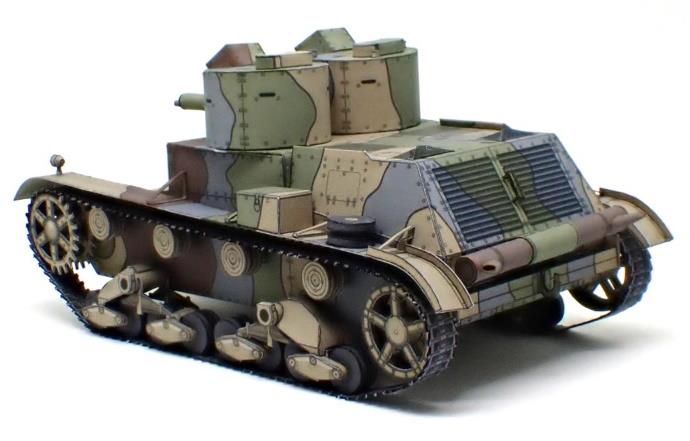
Created by the talented Japanese designer Hakoko, from the Box Studio website, here is a beautifully detailed paper model of the Polish light tank 7TP dw, in 1/48 scale. This is the twin-turret version, a true gem for fans of historic armored vehicles. 

The complete model spans five printed sheets, three with the main parts and two with textures for the underside, which are optional for less demanding modelers. 

The kit also includes six pages of richly illustrated instructions, making the assembly process clear and accessible even for those with little experience. 

The 7TP dw is a true rarity among World War II armored vehicles. Its name comes from 7 Tonowy Polski (or "7-ton, Polish") and refers to the early variant with two independent turrets , known as dwuwieżowy. 

Based on the British Vickers 6-Ton tank, the 7TP featured several local improvements, including reinforced armor and an innovative diesel engine. 

Three curious facts add even more charm to this model: it was one of the first tanks in the world to use a diesel engine, something quite rare at the time; only 24 units of the twin-turret version were produced before switching to a more efficient single-turret design; and although it was technically superior to the German Panzer I and II, the 7TP had limited impact during the 1939 invasion of Poland, mostly due to its low production numbers and poor tactical deployment.

Criado pelo talentoso designer japonês Hakoko, do site Box Studio, aqui está uma detalhada versão em papel do tanque leve polonês 7TP dw, na escala 1/48. Esta é a variante com torre dupla, um verdadeiro achado para os fãs de blindados históricos. 

O modelo completo ocupa cinco folhas impressas, três com as peças principais e duas com texturas para partes inferiores, estas últimas opcionais para os modelistas menos exigentes. 

Acompanha ainda um conjunto com seis páginas de instruções ricamente ilustradas, que tornam a montagem clara e acessível, mesmo para quem não tem tanta experiência. 

O 7TP dw é uma raridade entre os veículos blindados da Segunda Guerra Mundial. Seu nome vem de 7 Tonowy Polski (ou “7 toneladas, polonês”) e representa a versão inicial, com duas torres independentes, chamada de dwuwieżowy. 

Inspirado no Vickers 6-Ton britânico, o 7TP foi aprimorado localmente com blindagem reforçada e um inovador motor a diesel. 

Três curiosidades dão ainda mais charme a esse modelo: foi um dos primeiros tanques do mundo a usar motor diesel, o que era incomum na época; apenas 24 unidades da versão com torres duplas foram fabricadas, antes de se adotar o modelo de torre única; e, apesar de ser tecnicamente superior aos Panzer I e II alemães, o 7TP teve impacto limitado durante a invasão da Polônia em 1939, por conta de sua produção reduzida e emprego tático desfavorável.


Link:
Polish.7TPdw.Twin.Turret.Light.Tank.Paper.Model.In.1/48.Scale.by.Hakoko


More Paper Models of Tanks related posts: