Friday, March 15, 2024

WWI`s Fokker D.VII German Aircraft Paper Model In 1/64 Scale
by Paper Diorama

The best aircraft of the WWI in all its majesty, thanks to Paper Diorama, Italian website. This model occupies only two sheets of paper, with the stand and is in 1/64 scale. 

The Fokker D.VII was a German fighter aircraft developed during World War I. It stood out for its excellent flight performance and was considered one of the best fighters of the war. 

Its robust construction, maneuverability, and ability to climb rapidly made it a formidable threat to the Allies. 

The Fokker D.VII was so effective that, after the war ended, the Allies demanded that all aircraft of this model be handed over as part of the Germans' surrender terms, due to the fear of the air power it represented.

Its curved upper wing and aerodynamic profile were advanced for the time, contributing to its excellent maneuverability and stability in aerial combat. 

Despite being introduced late in the war, the Fokker D.VII influenced the design of military aircraft in the following decades. 

Its technology and design were studied and adapted by several nations for future fighter models.

O melhor Avião da Primeira Guerra Mundial em toda a sua majestade, graças ao site italiano Paper Diorama. Este modelo ocupa apenas duas folhas de papel, contando com o stand e está na escala 1/64. 

O Fokker D.VII foi um avião de caça alemão desenvolvido durante a Primeira Guerra Mundial. Ele se destacou por sua excelente performance de voo e foi considerado um dos melhores caças da guerra. 

Sua construção robusta, maneabilidade e capacidade de subir rapidamente o tornaram uma ameaça temível para os Aliados. 

O Fokker D.VII foi tão eficaz que, após o término da guerra, os Aliados exigiram que todas as aeronaves desse modelo fossem entregues como parte dos termos de rendição dos alemães, devido ao temor do poder aéreo que ele representava. 

Sua asa superior curvada e perfil aerodinâmico eram avançados para a época, contribuindo para sua excelente manobrabilidade e estabilidade em combate aéreo. 

Apesar de ter sido introduzido no final da guerra, o Fokker D.VII influenciou o design de aeronaves militares nas décadas seguintes. 

Sua tecnologia e design foram estudados e adaptados por várias nações para futuros modelos de caças.


Link:
WWI`s.Fokker.D.VII.German.Aircraft.Paper.Model.by.Paper.Diorama


More Aircraft Paper Models related posts:


Mikage Public Hall, Danjiri And Kobe Fashion Plaza Paper Models
by Kamiuchu

Paper Space Co., or Kamiuchu, is a Japanese company specializing in creating commercial papercrafts for all purposes, meeting a large demand in the Japanese market. 

At the request of Kobe City's Higashinada District, the company created this series of three papercrafts: the Mikage Public Hall and Danjiri, which are beloved in Higashinada District, and the Kobe Fashion Plaza on Rokko Island. 

You can download all of them for free at the official website of Higashinada District, Kobe City. My thanks to John Wagenseil, from Paper Modelers forum, a modeler friend from the USA who, through a thread called "Web Page with Collection of Paper Model Sites" that he updates almost daily, finds these rare papercrafts and shares them with all of us. 

The thread so far has more than 140 pages and, if we take into account that each page has an average of four finds, we have more than 500 different papercrafts to download. 

This post was only possible thanks to John's work, so all credit to him and his great thread, which is one of the best and most interesting on the entire Paper Modelers forum.

A Paper Space Co., ou Kamiuchu, é uma empresa japonesa especializada em criar papercrafts comerciais para todos os fins, atendendo a uma grande demanda do mercado japonês. 

A pedido do distrito de Higashinada da cidade de Kobe, a empresa criou esta série de três papercrafts: o Mikage Public Hall e Danjiri, que são adorados no distrito de Higashinada, e o Kobe Fashion Plaza na ilha de Rokko. Você pode baixar todos eles gratuitamente no site oficial do distrito de Higashinada, cidade de Kobe. 

Meus agradecimentos a John Wagenseil, do forum Paper Modelers, um amigo modelista do EUA que através de uma thread chamada "Web Page with Collection of Paper Model Sites" que ele atualiza quase que diariamente, encontra estes papercrafts raros e os divulga para todos nós. 

A thread já tem até o momento mais de 140 páginas e, se levarmos em conta que cada página tem em média quatro achados, temos mais de 500 papercrafts diferentes para download. 

Este post só foi possível graças ao trabalho de John, então todos os créditos a ele e sua ótima thread, que é uma das melhores e mais interessantes de todo o forum Paper Modelers.


Link to Kobe City papercrafts:
Mikage.Public.Hall.Danjiri.And.Kobe.Fashion.Plaza.Paper.Models.by.Kamiuchu

Link to John`s thread at Paper Modelers: Web.Page.With.Collection.Of.Paper.Model.Sites.by.John.Wagenseil


More Architectural Paper Models related posts:


Thursday, March 14, 2024

Quokka - The Happiest Animal In The World Paper Toy - by MAPS

Occupying only two printed sheets, this papercraft of a friendly Quokka was created by the Japanese designer MAPS exclusively for the Canon website. 

The Quokka is a small marsupial found mainly in Western Australia. It is known for its cute appearance and characteristic smile, which has made it popular on social media. 

It is often called "the happiest animal in the world" due to its facial expression that seems to be smiling, making it a phenomenon on social media. 

Quokkas are curious animals and are not afraid to approach humans, which makes them common subjects for selfies. However, it is important to remember that they are wild animals and should be treated with respect and care. 

They generally inhabit coastal areas and eucalyptus forests in Western Australia. They are mainly found on Rottnest Island and the adjacent mainland, where they are protected in natural reserves.

Ocupando apenas duas folhas impressas, este papercraft de um simpático Quokka foi criado pelo designer japonês MAPS exclusivamente para o site da Canon. 

O Quokka é um pequeno marsupial encontrado principalmente na Austrália Ocidental. Ele é conhecido por sua aparência fofa e sorriso característico, o que o tornou popular nas redes sociais. 

Ele frequentemente chamado de "o animal mais feliz do mundo" devido à sua expressão facial que parece estar sorrindo, o que o tornou um fenômeno nas redes sociais. 

Os Quokkas são animais curiosos e não têm medo de se aproximar dos humanos, o que os torna alvos comuns para selfies. No entanto, é importante lembrar que são animais selvagens e devem ser tratados com respeito e cuidado. 

Geralmente habitam áreas costeiras e florestas de eucaliptos na Austrália Ocidental. Eles são encontrados principalmente na Ilha Rottnest e no continente adjacente, onde são protegidos em reservas naturais.


Link:
Quokka.The.Happiest.Animal.In.The.World.Paper.Toy.by.MAPS


More Paper Models of Animals related posts:


Blauflesch Building Paper Model In N Scale - by Ausschneide Bogen

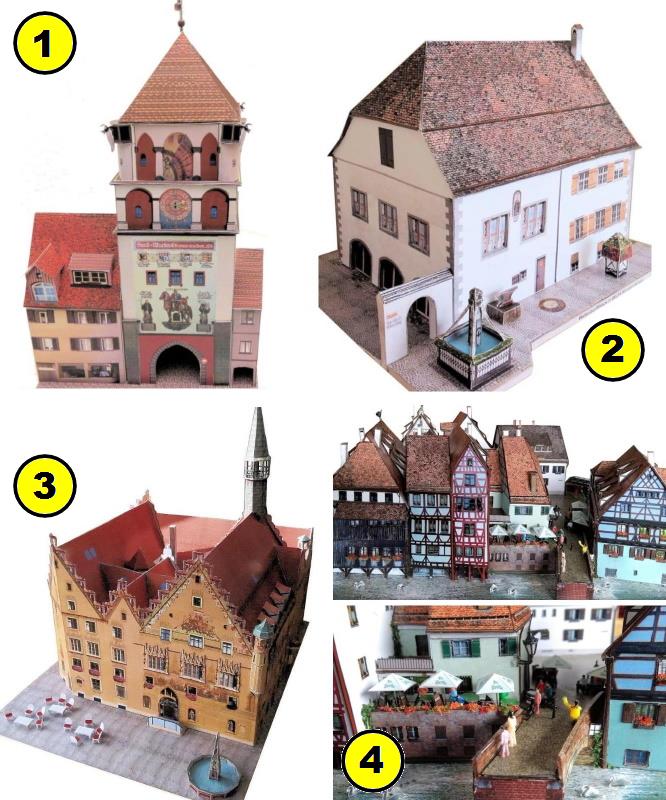
This paper model of the Blauflesch building is based on a real building located in the German city of Ulm, Germany. 

Perfect for Dioramas, RPGs and Wargames, the Blauflesch building is offered by the Ausschneide Bogen website and is in N scale (1/160 scale). 

The Blauflesch building was built by the “Construction and Savings Association of Civil Servants and Transport Workers of the State of Württemberg”. 

After just ten months of construction, 72 apartments, an inn, a general store, and a butcher's shop were completed in December 1902. 

Each apartment was between 15 and 25 square meters and had a kitchen, bathroom and three bedrooms. The residential units were modern and generously equipped for the time. 

The building, like much of the city of Ulm, was seriously damaged during the Second World War by an air raid on December 17, 1944, no longer had a roof and was rebuilt in a somewhat simpler form after the end of the Second World War.  

The Blauflesch building of the Ulm heimstätte shown on the model in its state after construction in 1903 was created from two black and white photos from the time and the floor plan of the ground-floor building. 

The color scheme was created intuitively compared to other buildings from the same era. The rear part of the building was intuitively created based on the current building. 

The Blauflesch restaurant has been the regular meeting place for Ulm's paper model makers for years and we hope it will continue to be so after the new contract. 

Attached to the model sheet is a small model of the Wiblinger Motorwagen from 1911, a predecessor of today's regular buses (Setra) from the Kässbohrer company from Ulm. 

My thanks to my friend Jo Kizinger from the USA for this beautiful find.

Este modelo de papel do edifício Blauflesch baseado em uma construção real situada na cidade alemã de Ulm, na Alemanha. Perfeito para Dioramas, RPG e Wargames, o edifício Blauflesch é oferecido pelo site Ausschneide Bogen e está na escala N (1/160 escala). 

O edifício Blauflesch foi construído pela “Associação de Construção e Poupança dos Funcionários Públicos e Trabalhadores dos Transportes do Estado de Württemberg”. 

Após apenas dez meses de construção, 72 apartamentos, uma pousada, um armazém geral e um açougue foram concluídos em dezembro de 1902. 

Cada apartamento tinha entre 15 e 25 metros quadrados e contava com cozinha, banheiro e três quartos. As unidades residenciais eram modernas e generosamente equipadas para a época. 

O edifício, como grande parte da cidade de Ulm, foi gravemente danificado durante a segunda grande guerra por um ataque aéreo em 17 de dezembro de 1944, não tinha mais telhado e foi reconstruído de forma um pouco mais simples após o fim da Segunda Guerra Mundial. 

O edifício Blauflesch do Ulm heimstätte mostrado no modelo em seu estado após a construção em 1903 foi criado a partir de duas fotos em preto e branco da época e da planta do edifício térreo. 

O esquema de cores foi criado intuitivamente em comparação com outros edifícios da mesma época. A parte posterior do edifício foi criada intuitivamente com base no edifício atual. 

O restaurante Blauflesch foi durante anos o ponto de encontro regular dos fabricantes de modelos de papel de Ulm e esperamos que continue a sê-lo após o novo contrato. 

Anexado à folha de modelo está um pequeno modelo do Wiblinger Motorwagen de 1911, um antecessor dos atuais ônibus regulares (Setra) da empresa Kässbohrer de Ulm. 

Meus agradecimentos ao meu amigo Jo Kizinger, dos EUA, por este belo achado.


Link:
Blauflesch.Building.Paper.Model.In.N.Scale.by.Ausschneide.Bogen


More Ausschneide Bogen Original Architectural Paper Models related posts:


Wednesday, March 13, 2024

Dagashi Shop Miniature Paper Model - by Retro Machine Club

This papercraft of a candy shop known in Japan as Dagashi is offered by Japanese website Retro Machine Club. 

There you will find the paper model of the store and another model of the store's interior, but the two are not to the same scale and do not look like they were made to match. 

What I did was combine the two models, leaving them on the same scale and I also made changes to the building, as it was very low and this would make it difficult to see the inside of the shop. 

I opened the front of the building, leaving the characteristic sliding doors on the sides and also changed the external textures, using material from other models offered on the website itself. 

I included more posters and a door at the back of the building. Another thing I did was to separately highlight the nice lady who seems to be the owner of the establishment, as in the original papercraft she was just printed in the background of the scene. 

Finally, I used more textures from the model itself to emulate the cards of sweets and toys that usually hang in front of the Dagashis. 

I gathered everything on a single sheet of paper, so you can imagine that the model, once assembled, will be very small, suitable for decorating your work desk or bookshelf. 

In addition to the link to this model, I will also leave the link to Retro Machine Club website so that you can download the original versions and many other papercrafts there.

Japanese stores known as Dagashi are popular for selling a wide variety of traditional Japanese sweets and snacks at affordable prices. 

The word "dagashi" means "cheap sweets" in Japanese, and these stores were popular among children in Japan from the 1950s to the late 80s. 

Dagashi stores offer a wide variety of sweets, snacks, chewing gum, and drinks, many of which are unique to Japan or difficult to find elsewhere. 

They are often sold in small, colorful and attractive packaging, often with anime or manga characters on the packaging. 

The prices of dagashi products are generally very low, with many items costing only a few yen. Because of this, dagashi stores have become known as a fun and affordable place for children to buy sweets with their pocket money. 

Although dagashi stores have been less popular in recent decades, they continue to be an icon of Japanese sweets and snacks culture and an important part of many Japanese childhoods. 

Some establishments still exist, and many dagashi sweets and snacks can also be found in supermarkets and convenience stores throughout Japan.

Este papercraft de uma lojinha de doces conhecida no Japão como Dagashi é oferecido pelo site japonês Retro Machine Club. 

Lá você vai encontrar o modelo de papel da loja e outro modelo do interior da loja, mas os dois não estão na mesma escala e não parecem ter sido feitos para combinarem. 

O que eu fiz foi combinar os dois modelos, deixando-os na mesma escala e também fiz alterações no prédio, já que ele era muito baixo e isso dificultaria ver o interior da lojinha.

Abri a frente do prédio deixando nas laterais as características portas de correr e ambém mexi nas texturas externas, usando material de outros modelos oferecidos no próprio site. Incluí mais posters e uma porta na parte de trás do prédio. 

Outra coisa que fiz foi destacar em separado a simpática senhora que parece ser a dona do estabelecimento, pois no papercraft original ela era apenas estampada no fundo do cenário. 

Por fim usei mais texturas do próprio modelo para emular as cartelas de doces e brinquedinhos que geralmente ficam penduradas na frente das Dagashis. 

Reuni tudo em uma única folha de papel, então você pode imaginar que o modelo depois de montado será bem pequeno, próprio para decorar sua mesa de trabalho ou estante. 

Além do link para este modelo, também deixarei o link do site Retro Machine Club para que vocês possam baixar as versões originais e muitos outros papercrafts que tem lá. 

As lojas japonesas conhecidas como Dagashi são populares por venderem uma grande variedade de doces e guloseimas tradicionais japonesas a preços acessíveis. 

A palavra "dagashi" significa "doces baratos" em japonês e essas lojas eram populares entre as crianças no Japão desde a década de 1950 até o final dos anos 80. 

As lojas dagashi oferecem uma grande variedade de doces, salgadinhos, chicletes e bebidas, muitos dos quais são exclusivos do Japão ou difíceis de encontrar em outros lugares. 

Eles costumam ser vendidos em pequenas embalagens coloridas e atraentes, muitas vezes com personagens de anime ou mangá em sua embalagem. 

Os preços dos produtos dagashi são geralmente muito baixos, com muitos itens custando apenas alguns ienes. 

Por causa disso, as lojas dagashi se tornaram conhecidas como um lugar divertido e acessível para as crianças comprarem guloseimas com o dinheiro da mesada. 

Embora as lojas dagashi tenham sido menos populares nas últimas décadas, elas continuam a ser um ícone da cultura de doces e guloseimas japonesas e uma parte importante da infância de muitos japoneses. 

Alguns estabelecimentos ainda existem, e muitos dos doces e guloseimas dagashi também podem ser encontrados em supermercados e lojas de conveniência em todo o Japão.


Link to Dagashi Shop:
Dagashi.Shop.Miniature.Custom.Paper.Model.by.Retro.Machine.Club


More Architectural Paper Models related posts: