Showing posts with label medieval. Show all posts

Saturday, March 30, 2024

An Easy-To-Build Modular Medieval Castle Papercraft For Kids
by Hugo L'Escargot

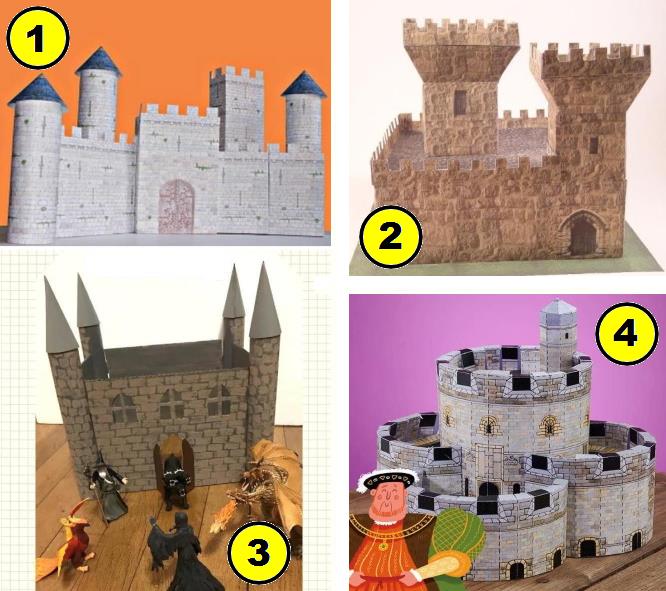
This modular papercraft of a medieval castle is offered by the educational website Hugo l'escargot. 

The castle has been available online for a few years, and I hadn't posted it here on the blog because I never found an image of it assembled, or even instructions for it. 

So I decided to build it in 3D, using Sketchup, and what I found while assembling it is that you can create various configurations, depending on the number of pieces and how you connect them to each other. 

Here in this post, I present two examples that I created using the pieces available in the downloadable template. 

Below each example, I've placed an image of the individual pieces. You'll notice that there are numbers below each piece. 

The numbers indicate how many times I used each piece in the assembly. 

I hope this helps those interested in building their own modular castle. It's a fairly easy project to execute and perfect for spending a productive afternoon with the kids, who will enjoy developing manual skills and exercising their imagination.

In the downloadable template, there's also a round tower, and the only reason I didn't use it in the examples in this post is that I couldn't assemble it properly in Sketchup. The 3D construction was easy, but I couldn't apply the textures because of the rounded shapes. 

Hugo l'escargot is a fictional character who has become popular in various forms of media, especially in cartoons and games. This character has appeared in a variety of contexts, including cartoons, children's books, educational games, and language learning materials. 

In many cases, Hugo is used as a central character to teach basic skills such as mathematics, reading, science, and foreign languages, especially for preschool and early school-aged children. 

Hugo l'escargot is often associated with French culture due to his name and the French language. He can be found in educational resources designed to teach French as a second language or as a foreign language. 

"L'escargot" is the French word for "snail." Hugo is often depicted as an anthropomorphic snail, meaning he has human-like characteristics, such as speaking and acting similarly to humans. 

Additionally, Hugo can also be found in computer games and educational apps, often in interactive adventures that involve solving puzzles and challenges to promote children's learning and cognitive development.

Este papercraft modular de um castelo medieval é oferecido pelo site educativo Hugo l'escargot. 

O castelo já está disponível há alguns anos na internet e eu não o havia publicado aqui no blog porque nunca achei uma imagem dele montado, ou mesmo instruções para ele. 

Resolvi então construí-lo em 3D, usando o Sketchup e o que descobri enquanto o montava é que você pode criar várias configurações, dependendo da quantidade de peças e de como as conecta umas com as outras. 

Aqui neste post deixo dois exemplos que criei usando as peças disponíveis no template para download. 

Embaixo de cada exemplo eu coloquei uma imagem das peças separadas. Você vai reparar que há números abaixo de cada peça. 

Os números indicam quantas vezes usei cada peça na montagem. 

Espero que isso ajude aqueles que se interessarem em construir seu próprio castelo modular. É um projeto bem fácil de executar e perfeito para passar uma tarde produtiva com as crianças, que aproveitarão para desenvolver habilidades manuais e exercitarem a imaginação. 

No template para download também há uma torre redonda e o único motivo que não a usei nos exemplos deste post é que eu não consegui montá-la adequadamente no Sketchup. A Construção em 3D foi fácil, mas eu não consegui colocar as texturas por causa das formas arredondadas. 

Hugo l'escargot é um personagem fictício que se tornou popular em diferentes formas de mídia, especialmente em desenhos animados e jogos. Este personagem apareceu em uma variedade de contextos, incluindo desenhos animados, livros infantis, jogos educativos e materiais de aprendizado de idiomas. 

Em muitos casos, Hugo é usado como um personagem principal para ensinar habilidades básicas, como matemática, leitura, ciência e línguas estrangeiras, especialmente para crianças em idade pré-escolar e em idade escolar inicial. 

Hugo l'escargot é frequentemente associado à cultura francesa devido ao seu nome e à língua francesa. Ele pode ser encontrado em recursos educacionais destinados a ensinar francês como segunda língua ou como língua estrangeira. 

"L'escargot" é a palavra francesa para "caracol". Hugo é frequentemente retratado como um caracol antropomórfico, o que significa que ele possui características humanas, como falar e agir de maneira semelhante aos humanos. 

Além disso, Hugo também pode ser encontrado em jogos de computador e aplicativos educacionais, muitas vezes em aventuras interativas que envolvem resolver quebra-cabeças e desafios para promover a aprendizagem e o desenvolvimento cognitivo das crianças.


Link:
An.Easy.To.Build.Modular.Medieval.Castle.Papercraft.For.Kids.by.Hugo.L'Escargot


More Medieval themed Architectural Paper Models related posts:


Friday, March 29, 2024

Castillo De Petrer In Spain Paper Model - by Constantino Callado

Created by Spanish designer and modeler Constantino Callado and offered by the official website of Petrer City Council, this is the paper model of Petrer Castle in Spain. 

The entire model occupies six printed sheets and there are two more sheets with instructions that, despite being only in Spanish, are very well illustrated. 

In the same file in PDF format you will find three more sheets with basic information (also in Spanish) about the history of the castle. 

If you are going to use this model for a school project or if you just want to know a little more about Castillo de Petrer, below I leave some things I discovered about it by searching the internet: 

The Castillo de Petrer, also known as Castillo de la Torreta, is a fortress located in the city of Petrer, in the province of Alicante, in the Valencian Community, Spain. 

The construction dates back to the Muslim period, with remains dating back to the 12th century. It was built by Muslims to protect the region and control the trade routes that passed through the area.

The castle's strategic hilltop location offers panoramic views of the surrounding region, which made it a crucial defensive position during the Middle Ages. 

After the Christian Reconquest of the region, the castle was conquered by Christians in the 13th century and underwent several expansions and renovations over the following centuries, reflecting changes in dominance and the defensive needs of the time. 

The castle's structure combines elements of Muslim and Christian architecture, showing the cultural and stylistic influences of both historical periods. 

Today, part of the castle houses an archaeological museum that displays historical artifacts found in the region, offering visitors a fascinating insight into local history from ancient times to the medieval era. 

In addition to its historical importance, Castillo de Petrer also serves as a setting for cultural events such as music festivals, theater and art exhibitions, contributing to the city's vibrant cultural life. 

There are local legends that suggest the Knights Templar may have had some involvement with the castle during the Middle Ages, adding a touch of mystery and fascination to its history. 

In recent years, the castle has undergone a restoration process to preserve its historic structure and make it accessible to visitors, allowing future generations to appreciate its beauty and cultural importance.

Criado pelo designer e modelista espanhol Constantino Callado e oferecido pelo site oficial da Prefeitura de Petrer, este é o modelo de papel do Castelo de Petrer, na Espanha. 

O modelo todo ocupa seis folhas impressas e há mais duas folhas com instruções que apesar de estarem apenas em espanhol, são muito bem ilustradas. 

No mesmo arquivo em formato PDF você encontrará mais três folhas com informações básicas (também em espanhol) sobre a história do castelo. 

Se você for usar este modelo para um trabalho escolar ou se você apenas quer saber um pouco mais sobre o Castillo de Petrer, abaixo deixo algumas coisas que descobri sobre ele pesquisando na internet: 

O Castillo de Petrer, também conhecido como Castillo de la Torreta, é uma fortaleza localizada na cidade de Petrer, na província de Alicante, na Comunidade Valenciana, Espanha. 

A construção remonta ao período muçulmano, com vestígios que datam do século XII. Foi construído pelos muçulmanos para proteger a região e controlar as rotas comerciais que passavam pela área. 

A localização estratégica do castelo no topo de uma colina oferece uma vista panorâmica da região circundante, o que o tornava uma posição defensiva crucial durante a Idade Média. 

Após a Reconquista Cristã da região, o castelo foi conquistado pelos cristãos no século XIII e passou por várias ampliações e reformas ao longo dos séculos seguintes, refletindo as mudanças de domínio e as necessidades defensivas da época.

A estrutura do castelo combina elementos de arquitetura muçulmana e cristã, mostrando as influências culturais e estilísticas de ambos os períodos históricos. 

Atualmente, parte do castelo abriga um museu arqueológico que exibe artefatos históricos encontrados na região, oferecendo aos visitantes uma visão fascinante da história local desde os tempos antigos até a era medieval. 

Além de sua importância histórica, o Castillo de Petrer também serve como cenário para eventos culturais, como festivais de música, teatro e exposições de arte, contribuindo para a vida cultural vibrante da cidade. 

Existem lendas locais que sugerem que os Cavaleiros Templários podem ter tido algum envolvimento com o castelo durante a Idade Média, adicionando um toque de mistério e fascínio à sua história. 

Nos últimos anos, o castelo passou por um processo de restauração para preservar sua estrutura histórica e torná-lo acessível aos visitantes, permitindo que as gerações futuras apreciem sua beleza e importância cultural.


Link:
Castillo.De.Petrer.In.Spain.Paper.Model.by.Constantino.Callado


More Paper Models of Castles related posts:


Thursday, March 7, 2024

Schönberg Observation Tower Paper Model - by Ausschneide Bogen

This paper model of the Schönberg Observation Tower is offered by the German website Ausschneide Bogen. 

The model can be downloaded in two different scales: 1/87 (H0 scale), which occupies six printed sheets, and 1/160 (N scale), two sheets, with internal cardboard reinforcement being recommended for the 1/87 scale model. 

Around 1894, while hiking on the Schönberg plateau, hiking friends Louis Laiblin, Eugen Nägele and Joseph Krauß came up with the idea of building an observation tower there. 

The paper manufacturer Laiblin made the construction possible with a generous donation and so the "Pfullinger Unterhose" was built between 1905 and 1906 according to plans by the architect Professor Theodor Fischer for 17,000 marks (equivalent to around 200,000 euros today) as first observation tower to be built in reinforced concrete in Germany. 

In 1926, the wooden shingles were replaced by a copper roof. In the spring of 1945, the French army damaged the roof of the upper tower with an air raid. Repairs took place in 1949 and renovation work took place in 1965 and 1982. 

The approximately 28 meter high tower can be reached via 108 steps and is constantly open. My thanks to my friend Jo Kizinger, from the USA, for this nice find.

Este modelo de papel da Torre de Observação de Schönberg é oferecido pelo site Ausschneide Bogen, da Alemanha. 

O modelo pode ser baixado em duas escalas diferentes: 1/87 (escala H0), que ocupa seis folhas impressas e 1/160 (escala N), duas folhas, sendo recomendado um reforço interno de papelão no modelo em escala 1/87. 

Por volta de 1894, enquanto caminhavam no planalto de Schönberg, os amigos caminhantes Louis Laiblin, Eugen Nägele e Joseph Krauß tiveram a ideia de construir ali uma torre de observação. 

O fabricante de papel Laiblin tornou a construção possível com uma generosa doação e assim o "Pfullinger Unterhose" foi construído entre 1905 e 1906, de acordo com os planos do arquitecto Professor Theodor Fischer por 17.000 marcos (equivalentes a cerca de 200.000 euros hoje) como primeira torre de observação a ser construída em concreto armado da Alemanha. 

Em 1926, as telhas de madeira foram substituídos por um telhado de cobre. Na primavera de 1945, o exército francês danificou o telhado da torre superior com um ataque aéreo. Os reparos ocorreram em 1949 e as obras de renovação ocorreram em 1965 e 1982. 

A torre de aproximadamente 28 metros de altura pode ser alcançada através de 108 degraus e está constantemente aberta. Meus agradecimentos ao meu amigo Jo Kizinger, dos EUA, por este achado bem legal.


Link:
Schönberg.Observation.Tower.Paper.Model.by.Ausschneide.Bogen


More Ausschneide Bogen Original Architectural Paper Models related posts:


Friday, February 23, 2024

Templates For A Cardboard House For Dioramas And Wargames
by Papermau - Download Now!

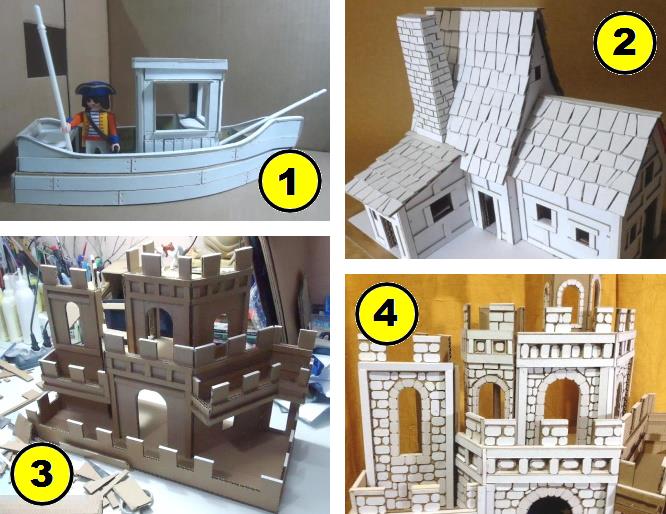
I created these templates of a medieval-style house with the idea that it could be useful for dioramas and wargames. 

I named and numbered the pieces and, with the images that illustrate this post, I believe it will be enough for those who venture into building their own medieval house. 

As you can see, the model has a ground floor and a staircase that leads to the upper floor via a balcony. Maybe later I will publish a version with textures, but that will be for the future. 

In addition to the templates to print, I will leave another link to the 3D version that can be viewed in Sketchup and another link for anyone who wants to download an old, free version of Sketchup. 

I will also leave one more link to another cardboard house with downloadable templates that I published here on the blog in 2019. 

In this post you will see some photos of the model assembly and some tips on what type of cardboard and glue to use, etc. Have fun.

Eu criei estes templates de uma casa em estilo medieval com a idéia que pudesse ser útil para dioramas e wargames. 

Eu nomeei e numerei as peças e, com as imagens que ilustram este post, eu creio que será o bastante para aqueles que se aventurarem em construir sua própria casa medieval. 

Como vocês podem ver o modelo tem um andar térreo e uma escadaria que leva ao andar superior por uma varanda. Talvez depois eu publique uma versão com texturas, mas isso vai ficar para o futuro. 

Além dos templates para imprimir, vou deixar outro link para a versão 3D que pode ser visualizada no Sketchup e mais outro link para quem quiser baixar uma versão antiga e gratuíta do Sketchup. 

Ainda vou deixar mais um link para uma outra casa de papelão com templates para baixar que eu publiquei aqui no blog em 2019. 

Neste post você verá algumas fotos da montagem do modelo e algumas dicas de que tipo de papelão, papel cartão e cola usar, etc. Boa diversão.


Link to download the templates:
Cardboard House Templates For Dioramas And Wargames - by Papermau


More Papermau Original Cardboard Projects related posts:


Sunday, February 11, 2024

The Old Castle - A 1979`s Papercraft From USRR - by Z.L. Venediktova
via The Most Important Things From Your Childhood

"The Most Important Things From Your Childhood", in a direct and literal translation from Russian, is a website dedicated to preserving "scans of games and magazines from the former Union of Soviet Socialist Republics (USSR)". 

This papercraft of a medieval castle that occupies five printed pages and whose original name on the cover is translated as "Old Castle", was created in 1979 by artist Z.L. Venediktova and, as you can see in the image right below, I assembled two sections of the castle in Sketchup, just to see if the pieces fit together correctly, as this model was certainly designed by hand. And yes, everything fits perfectly. 

On the back cover it is stated that it is a recommended model for children aged seven to ten years old and that the price was 50 Soviet kopecks. 

In 1979, 100 kopecks were equivalent to 1 ruble in the Soviet Union, so this papercraft cost half a ruble. 

In 1979 in the Soviet Union, one ruble could buy a variety of basic consumer items such as bread, milk, eggs, vegetables and some other dietary necessities. 

However, the purchasing power of the Soviet ruble varied depending on the availability of products and the region of the country. 

Additionally, durable goods and luxury products could be much more expensive and therefore out of reach for most people. 

State control over the economy meant that the prices and availability of goods were often regulated by the government, which we know, from experience around the world and including in Brazil, never works. 

State-controlled economies are doomed to failure, corruption and inflation. 

And please don't take my word for it. Instead, do your own research and draw your own conclusions. 

Information is power and that's why they want to "regulate" social media around the world, including in Brazil.

"As Coisas Mais Importantes Da Sua Infância", de uma tradução direta e literal do russo, é um website dedicado a preservar "scans de jogos e revistas da antiga União das Repúblicas Socialistas Soviéticas (URSS)". 

Este papercraft de um castelo medieval que ocupa cinco folhas impressas e cujo nome original na capa é traduzido como "Velho Castelo", foi criado em 1979 pelo artista Z.L.Venediktova e, como vocês podem ver na imagem logo acima, eu montei duas sessões do castelo no Sketchup, apenas para ver se as peças se encaixavam corretamente, já que certamente este modelo foi projetado à mão. E sim, tudo se encaixa perfeitamente. 

Na contracapa informa-se que é um modelo recomendável para crianças de sete a dez anos de idade e que o preço era de 50 kopecks soviéticos. 

Em 1979, 100 kopecks equivaliam a 1 rublo na União Soviética, então este papercraft custava meio rublo. 

Em 1979, na União Soviética, um rublo poderia comprar uma variedade de itens de consumo básicos, como pão, leite, ovos, vegetais e algumas outras necessidades alimentares. 

No entanto, o poder de compra do rublo soviético variava dependendo da disponibilidade de produtos e da região do país. 

Além disso, bens duráveis e produtos de luxo poderiam ser muito mais caros e, portanto, fora do alcance para a maioria das pessoas. 

O controle estatal sobre a economia significava que os preços e a disponibilidade dos bens eram frequentemente regulados pelo governo, o que se sabe, por experiências em todo o mundo e inclusive no Brasil, que nunca dá certo. 

Economias controladas pelo Estado estão fadadas ao fracasso, corrupção e inflação. 

E por favor, não acredite em minhas palavras. Ao invés disso, pesquise por conta própria e tire suas próprias conclusões. 

Informação é poder e por isso querem "regulamentar" as mídias sociais em todo o mundo, inclusive no Brasil.


Link:
The.Old.Castle.A.1979`s.Papercraft.From.USRR.by.Z.L.Venediktova


More Paper Models of Medieval Castles related posts: